Best Clubs in Barcelona
Barcelona's club map splits by area before it splits by taste: the belt out in Poblenou and the Marina blocks, the techno rooms with their own circuit, the beach clubs on the seafront, and the old-city floors around Plaça Reial that start as something else and end as a club.
One thing to know before the names: they move. Rooms here rebrand and change hands often enough that half the club lists you find online point at venues that no longer use those names. Treat the names below as the shape of the city and the live pages as the current truth.
The big rooms
Razzmatazz is the one most visitors are pointed at, and for once the consensus is defensible: a multi-room building that runs live shows and club nights under the same roof, so the same address can be a concert on Thursday and several dance floors on Saturday. Check what is actually programmed rather than assuming the building has one sound.
Sala Apolo works the same double life at a different scale, with La [2] de Apolo downstairs as its smaller room. Between them they cover a lot of the city's week — gigs, club nights, and the sessions that sit somewhere between the two.
Techno and electronic
Moog is the anchor and the outlier: a techno club that programmes 365 nights a year, which makes it the answer to the question nobody else in the city can answer on a Monday. INPUT runs the dance-club end of the same circuit, Laut covers electronic and live, and WOLF works a Thursday-to-Saturday shape.
This is the part of the scene where the lineup matters more than the room. People here pick the artist first, and the night sells accordingly — often through a ticketing app, hours before doors.
The beachfront and Port Olímpic rooms
Opium is the beachfront one, and the Barcelona cliché that is also genuinely full most of the summer. Shôko, Sutton and KU Barcelona — the club that was Pacha Barcelona until the rebrand — work the same water, and between them they carry the largest followings in the city's club layer. In summer this is where the visitor volume lands, which is either the point or the reason to avoid it.
La Terrrazza is the seasonal one: an open-air club that exists in summer and does not exist the rest of the year, so it is at full strength exactly when the city is busiest. City Hall sits at the other end of the calendar, programming every day of the year by its own account.
Small, strange and late
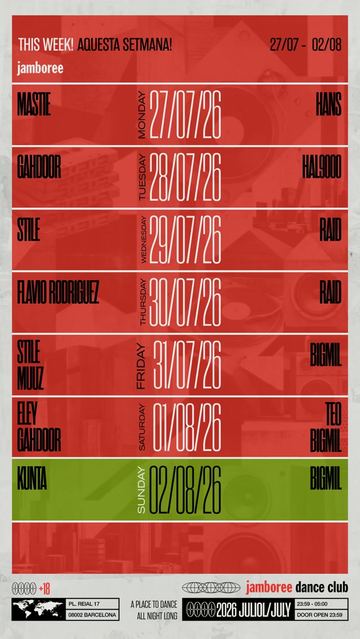
Jamboree is the double act: a jazz club with a nightly programme that is also a dance club, so one door can get you two different nights. Marula Café works the funk and soul lane, Curtis Audio Club is an audio bar as much as a club — the name is the programming statement — and Meteoro in Raval is the bar-that-is-a-club shape the neighbourhood does well.
La Paloma deserves its own line: a historic ballroom that programmes Latin and salsa alongside club nights, and one of the few rooms in the city where the building itself is part of the reason to go.
When the name in the listicle no longer exists
Two current examples, both recent. Sidecar, on Plaça Reial, is now Club Sauvage. Pacha Barcelona is now KU Barcelona. Neither venue vanished; both are still programming under new names, and every travel guide written before the change still sends people to the old one.
This is the routine failure mode of static club lists in this city, and the reason the venue pages here are worth more than the rankings: they follow what the room is doing now rather than what it was called when somebody wrote about it.
Tickets, lists and the door
The default route in is a ticket bought ahead through an app, on more nights than the beach-club reputation would suggest. A named lineup can sell out during the afternoon; turning up cold at peak on a Saturday is the single most reliable way to spend an hour outside a room you never get into.
The door still works for ordinary nights at small rooms, and some nights carry reduced or free entry inside a stated window — where they do, the listing says so, because it is a fact about that night rather than about the venue. Nothing else about prices is quoted here for the same reason: the announcement for that night is the source of truth.
Good to know
What is the most famous club in Barcelona?
Razzmatazz gets named more than anything else — a multi-room building running live shows and club nights at once, and the one most first-time visitors are sent to. Within the electronic scene specifically, Moog carries more weight: it programmes 365 nights a year and is the room people name when they mean techno rather than a night out.
Are Barcelona clubs open every night?
Some are, most are not. Moog programmes 365 nights a year, City Hall claims every day of the year, and Jamboree runs a nightly jazz programme that turns into a club floor afterwards. Beyond those, the club layer concentrates from Thursday to Saturday — WOLF, for instance, works that shape — while the live rooms and the theatre circuit carry the weeknights.
How do you get into clubs in Barcelona?
Buy ahead. Most club nights with a lineup sell through ticketing apps before the night, and the good ones go during the day. Some nights have reduced or free entry inside a stated window, and where that is true the listing for that night says so. The door is a reasonable plan at small rooms on ordinary nights and a poor one at the big rooms on a Saturday.
Updated 2026-07-28